
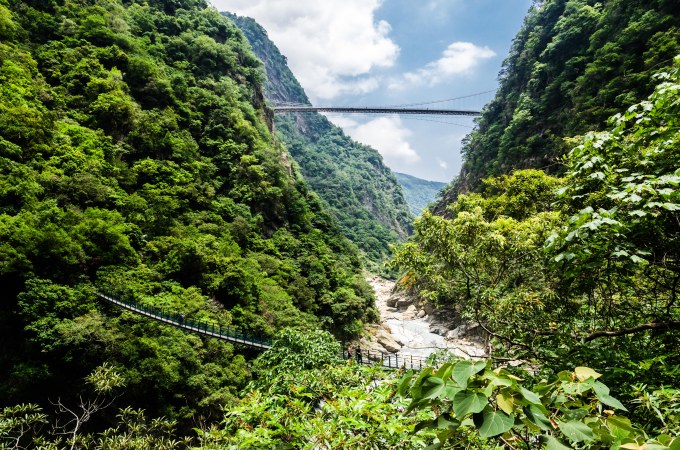
We got an early start from Hualien, keen to be ahead of the tour buses out of town. We headed north along the coast and stopped at a couple of places to take some photos of the Qingshui Cliff, which was rather impressive. More impressive is the effort involved in building railways and roads down the coast. Every year Taiwan gets hammered by typhoons, and less regularly earthquakes (there was an earthquake in Taiwan the day before we arrived) so after every typhoon the roads and railway lines have to be checked for damage. Often the roads are closed while repairs are made. In the park proper, we visited a bridge whose predecessor had been destroyed by a typhoon in August 1997. A new bridge was built only to be destroyed in August 2003. The new one is still there, but August isn’t far away.
Once in the park we drove through the Taroko Gorge towards our accommodation, a hostel at the Presbyterian Church in the village of Tianxiang. Having checked in we headed off to explore some of the sights. We saw some very impressive scenery and amazing marble cliffs. Yes, marble. The gorge is 19 kilometres of solid marble with the Liwu river flowing through it, creating cliffs hundreds of metres high. We did some walking on trails, which despite the heat and humidity, was well worth it, and walked through Swallow Grotto, a part of the gorge where swallows fly around catching insects. You can walk along the road through the tunnels and half tunnels (with hard hat on to protect you from falling rock – the hard hats can be borrowed for no cost from the park offices) admiring the spectacular gorge and the huge chunks of rock in the river bed. We finished the day by finding a place by a river where we could soak our feet. We found out later it is illegal to swim in the park, but does that include soaking your feet? We were back at the hostel late afternoon.

One advantage of being almost 500 metres above sea level was that the temperature fell nicely in the evening, which made a nice change. We could sit outside comfortably, however the local biting insects were a minor nuisance until the DEET was applied.
On Saturday we were up early and set off in the car to do some more exploring. The weather wasn’t so good; overcast and we had a bit of rain. But it wasn’t so hot which was nice. We started by doing an 8 kilometre (there and back) stroll along the Shakadang river (there are several rivers in the park). Most of the way we were above the river, but in other places we could easily have got to the river and had a swim in one of the many deep and inviting-looking pools, but that isn’t allowed. We encountered some local wildlife including snails, dragonflies, butterflies, a couple of very small frogs, and some rather large spiders.
After doing that walk we visited the Geological Exhibit Hall (it was raining) where they had some nice displays of rock types found in the park, and information about tectonic plates and their part in shaping this part of the world. It would have been better if all the signage hadn’t only been in Chinese, but it was a nice enough way to pass some time. Then we went back to Tianxiang and explored the village. We walked up to the temple complex and looked at some local shops. The views from the village are rather nice, especially when you can see where the TaciJilli river and the Dasha river meet. The two rivers are very different in colour; the Dasha appears to be carrying a lot of eroded rock so is grey in colour (reminding me of the Waiho river at Franz Josef in New Zealand), whereas the Tajillic is much clearer and turquoise in colour. When they meet they remain distinct for a short distance before becoming one; the Liwu river, which then flows through the gorge.
After doing all that we decided to drive further up the road beyond Tiangxiang. This road is called the Central Cross-Island Highway and cost 212 or 225 or 226 (it depends on which sign you are reading) lives to build back in the 1950s. This was an interesting drive; only one lane in many places and with multiple hairpin bends, not to mention the tunnels. As in the rest of the park the speed limit is 40 kph, dropping to 30 in places, yet the locals like to go a lot faster. They also like to straight-line the curves, even in places where the road is two lanes wide. It’s not pleasant when you are going the other way and encounter one of them in your lane. There are convex mirrors on the side of the road to allow you to see around most of the curves. In places where the road narrows, the locals don’t like to wait for you to pass, so you end up inching past each other, trying to not put the right hand wheels of your car in the deep gutter (we saw a car this had happened to east of Tianxiang) or scraping along the Armco barrier. The views from the road were spectacular but our nerves were becoming a bit frayed despite the very strong looking Armco barrier between us and certain death (the drop from the road was rather steep and long), so we decided we had seen enough, and once we found a place to turn around safely we did so. The problem is not so much the road, as the way the locals drive on it, just like in New Zealand. The highest point on this road is 3,275 metres above sea level, we didn’t get that far but we certainly gained some altitude.

As we were turning around we saw a monkey in a tree by the roadside, but he didn’t like the look of us and disappeared. We saw another one further down the road much nearer Tianxiang, but he wasn’t sociable either. So with that adventure behind us, we headed back to the hostel for dinner. We had the dashcam going on the drive so when we find time we will put up a video.
On Sunday we did another trail, the bit of it that was open at least. We also revisited a few places we particularly like in the park. Generally, however, this was a more relaxed day. I don’t think many people spend three days in the park but we were glad we did.
The only disappointment in the park is the number of trails we wanted to do but couldn’t due to them being closed; the result of typhoon and earthquake damage. But Nature gives and Nature takes away. Apart from that we thoroughly enjoyed our time there. It really is a special place with scenery that is up there with anything I have seen elsewhere. The gorge really is something special. There are ample examples where the rock has come under pressure due to tectonic pressure, and the colouration and wave forms in the rock turn them into art. Photos do not do it justice, you should go and see it for yourself. Tianxiang (I have seen three different spellings of this name) is nice too, very peaceful and being able to sit outside in the evening was pleasant. The only other quibble was not seeing any snakes. There are several species in the park, and at times they are frequently seen but I guess we needed to be there later in the year.
Thanks to everyone who is looking at our website. You can follow us on Instagram too.
If anyone has any questions about travelling in Taiwan, feel free to contact us at thekiwiandthekraut@gmail.com



 The Kiwi & The Kraut